
Whispers Beneath Jambatan Tamparuli
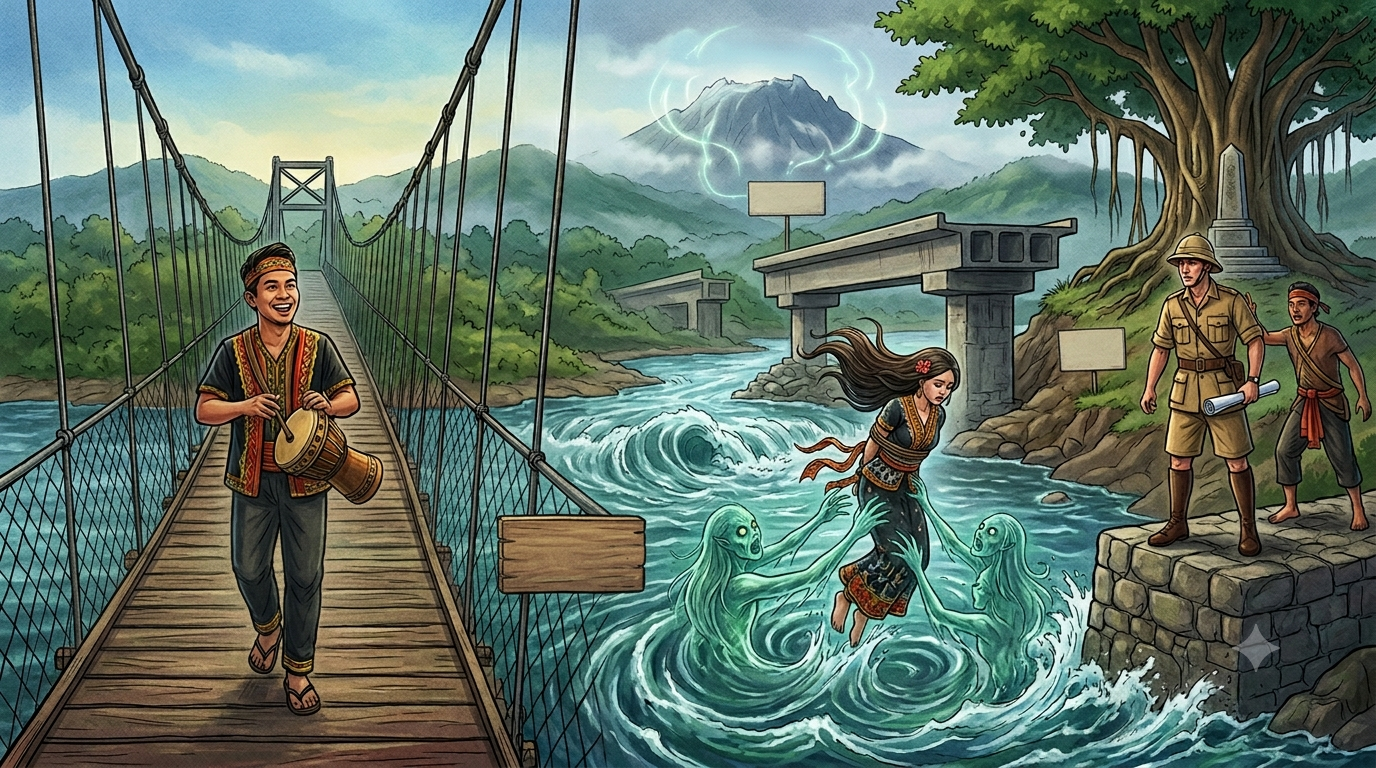
There was once a time when the people of Tamparuli feared the river more than the jungle.
The river cut through the land like a living thing — powerful, unpredictable, and impossible to tame. During the dry season, it flowed quietly beneath the sun, reflecting the sky like polished glass. But when the rains came, it transformed into a raging force that swallowed trees, swept away livestock, and isolated entire villages from one another.
The people needed a bridge.
Without it, children could not safely travel to nearby settlements, traders struggled to cross with their goods, and families remained divided whenever the waters rose. So the villagers gathered timber from the forests, tied thick ropes by hand, and worked tirelessly to build a crossing over the river.
But the river rejected it.
The first bridge collapsed before sunrise.
The villagers blamed weak foundations and rebuilt it stronger. Yet days later, the river rose violently and tore it apart again. The third bridge lasted only a little longer before it too disappeared into the current.
Fear slowly spread through the village.
Some believed the river was cursed. Others whispered that unseen spirits guarded the waters and refused to let the people cross. The elders began speaking in lowered voices whenever night fell, for in Bornean folklore, rivers were never simply rivers. They were believed to possess memory, emotion, and power beyond human understanding.
Desperate for answers, the villagers sought the guidance of a spiritual elder. After days of prayer and ritual, the elder finally spoke words that chilled everyone present.
The river demanded a sacrifice.
Silence consumed the gathering.
No one wanted to believe it. Yet the failures continued. Every attempt to complete the bridge ended in destruction, as though the river itself was swallowing human effort whole.
Among the villagers lived a young woman named Solungkoi.
Stories describe her as graceful and kind-hearted, admired not only for her beauty but for her quiet strength. In some tellings of the legend, Solungkoi had fallen deeply in love with a foreign bridge builder who had come to help the village. In others, she was simply a daughter of the community who understood the suffering of her people.
What remains consistent across generations is this:
Solungkoi chose sacrifice.
It is said that on the night before the final construction began, she walked alone toward the riverbank beneath the cover of darkness. Some versions claim she willingly offered herself to the spirits of the river. Others say her death became a tragic necessity decided by desperate men. Time has blurred the truth, leaving only sorrow behind.
The next morning, the waters were calm.
For the first time since construction began, the bridge stood firm.
No storm tore it apart.
No current carried it away.
The villagers crossed the bridge in silence, knowing the structure before them had been paid for with a human life. What should have been a moment of celebration instead became one of mourning.
And so the bridge endured.
Generations passed. Children grew hearing fragments of the tale from their grandparents. Travellers crossed the bridge without knowing whose memory lingered beneath the wooden planks. Yet the old people never forgot.
Even today, some still say the river beneath Jambatan Tamparuli carries echoes of Solungkoi’s spirit. When heavy rains arrive and the waters roar against the pillars at night, elders warn against mocking the river or speaking carelessly near its banks.
Because some believe the river remembers everything.
Not every bridge is built with wood and rope alone.
Some are built with sacrifice.
Some with grief.
And some with stories too painful for history to fully let go.